UI/UX
Boosting First-Order AOV by 48% through Better Incentive Visibility
Glamzy is a fast-growing beauty and wellness brand with both an online store and physical retail presence. To attract new customers, we ran paid ads with a simple promise — "Free gift on orders above ₹399."
Clicking the ad brought users to Glamzy's mobile website. But once they landed, something was off. Despite seeing the free gift offer moments before, most first-time users were placing orders below ₹399 — leaving the gift unclaimed and the brand unable to recover its ad spend.
My goal was simple: Redesign the experience from landing page to checkout, so that users who arrived with the free gift promise in mind were actually motivated to follow through — spending ₹399 or more, turning ad spend into real profit for the business.
Year
2025
Client
Glamzy
Industry
Ecommerce
Roles
UX and UI Designer

01 — Context
First-time users — especially those from paid ads — were placing low-value orders (AOV ₹288) and rarely crossing the ₹399 free gift threshold. Acquisition costs were hard to recover, directly impacting revenue. A key gap: users were unaware of incentives during checkout, limiting their motivation to spend more.
02 — Outcome
Impact
+48%
Increase in AOV
₹288 → ₹427
+212%
Increase in free gift claims
−81%
Drop in shipping-related abandonment
03 — Audience
Target Audience
Paid Ad Users
New users landing on the Glamzy app or browser through Meta ads, attracted by the free gift promise.
Tier 2 & 3 City Shoppers
First-time shoppers from Tier 2 and Tier 3 cities, often price-sensitive and incentive-driven in their purchase decisions.
Organic First-Time Visitors
Organic visitors exploring Glamzy for the first time, with no prior brand familiarity or loyalty.
04 — Current Flow
Here is what happened when a user entered the Glamzy app after seeing the free gift ad.
1) Ad → Lands on Homepage
Users see an ad promising a free gift on first order and land on the platform. Expectation: "I'll receive a free gift."
2) Exploration (PLP / PDP)
Users browse and add products to cart. Gap: No reinforcement of the free gift offer during browsing.
3) Cart Page
Scenario A: Cart ≥ ₹399
• Offer automatically applied.
• Free gift becomes visible.
User proceeds smoothly.
Scenario B: Cart < ₹399
• Free gift not visible.
• Coupon appears disabled.
User feels confused: "How do I get the free gift now?"
The Result
Users with cart value below ₹399 had to recall offer conditions on their own — or navigate to the offers section to find free gift eligibility.
This caused a confusion & effort loop — some users abandoned, others proceeded without increasing their cart value.
Key Insight: The experience relied on users to remember offer conditions and take action themselves, instead of guiding them at the right moment.
05 — Research
Research Approach
To understand why users were not claiming the free gift, I combined behavioural data with qualitative insights from three complementary research methods.
Cart Activity Analysis
Analyzed 1 month of cart activity and order patterns to understand drop-off points and threshold behaviour.
Heatmap Recordings
Reviewed heatmap recordings to observe where users tapped, paused, and dropped off during the cart flow.
User Interviews & Support
Conducted user interviews and gathered recurring themes from customer support tickets to identify pain points.
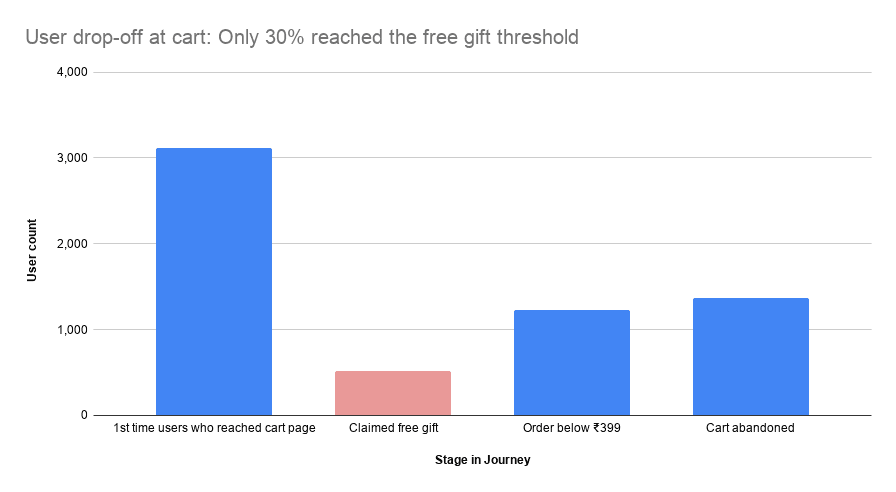
Out of 3,120 users who reached the cart page, only 520 (~30%) completed purchases above ₹399 and claimed the free gift.
06 — Insights
Key Insights
Incentives not visible enough
Free gift and shipping offer conditions were hidden and never surfaced at the right moment in the user journey.
High cognitive effort
Users had to actively seek out offer conditions themselves, placing unnecessary mental burden at the point of purchase.
Effort outweighed perceived value
The free gift wasn't presented compellingly enough for users to feel it was worth adding more items to their cart.
Cart became a drop-off point
07 — Opportunities
Opportunity Areas
Incentive Visibility
Improve visibility of incentives at the cart stage so users are aware of the free gift before they check out.
Reduce Cognitive Effort
Reduce cognitive effort required to reach the ₹399 threshold by guiding users with clear progress cues.
Clear Gift Unlocking
Make the gift unlocking process clear and simple — users should immediately understand what they need to do.
Cart as Conversion Moment
Turn the cart into a conversion-driving moment instead of a drop-off point by surfacing the right incentives at the right time.
08 — Objectives
Business Objectives
Increase Incentive Visibility
Increase visibility of free gift and shipping incentives at key decision points in the purchase journey.
Reduce User Effort
Reduce user effort required to understand and unlock offers — make it effortless to claim the free gift.
Build Trust
Build trust through clear communication of pricing, delivery charges, and offer benefits at every touchpoint.
Encourage ₹399 Threshold
Encourage users to reach the ₹399 threshold during checkout to improve first-order AOV and recover acquisition costs.
09 — Benchmarking
To understand how leading platforms handle incentive visibility and reduce drop-offs, I analyzed competitor cart experiences focusing on how and where offers are surfaced.
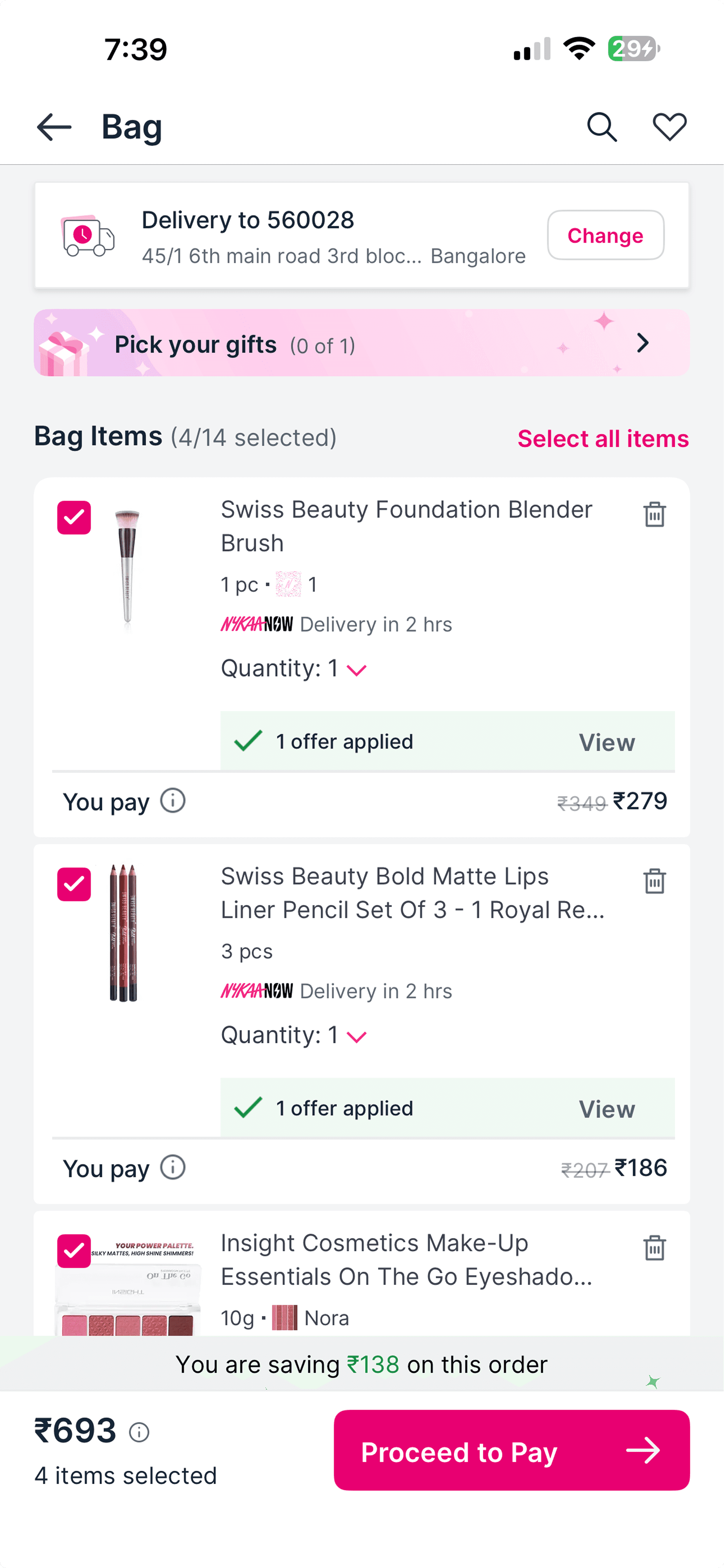
Nykaa
Competitor 1 — Top Placement
Free gift is surfaced prominently at the top of the cart.
Insight: Incentives are treated as a primary element, not secondary information — ensuring users notice them immediately.
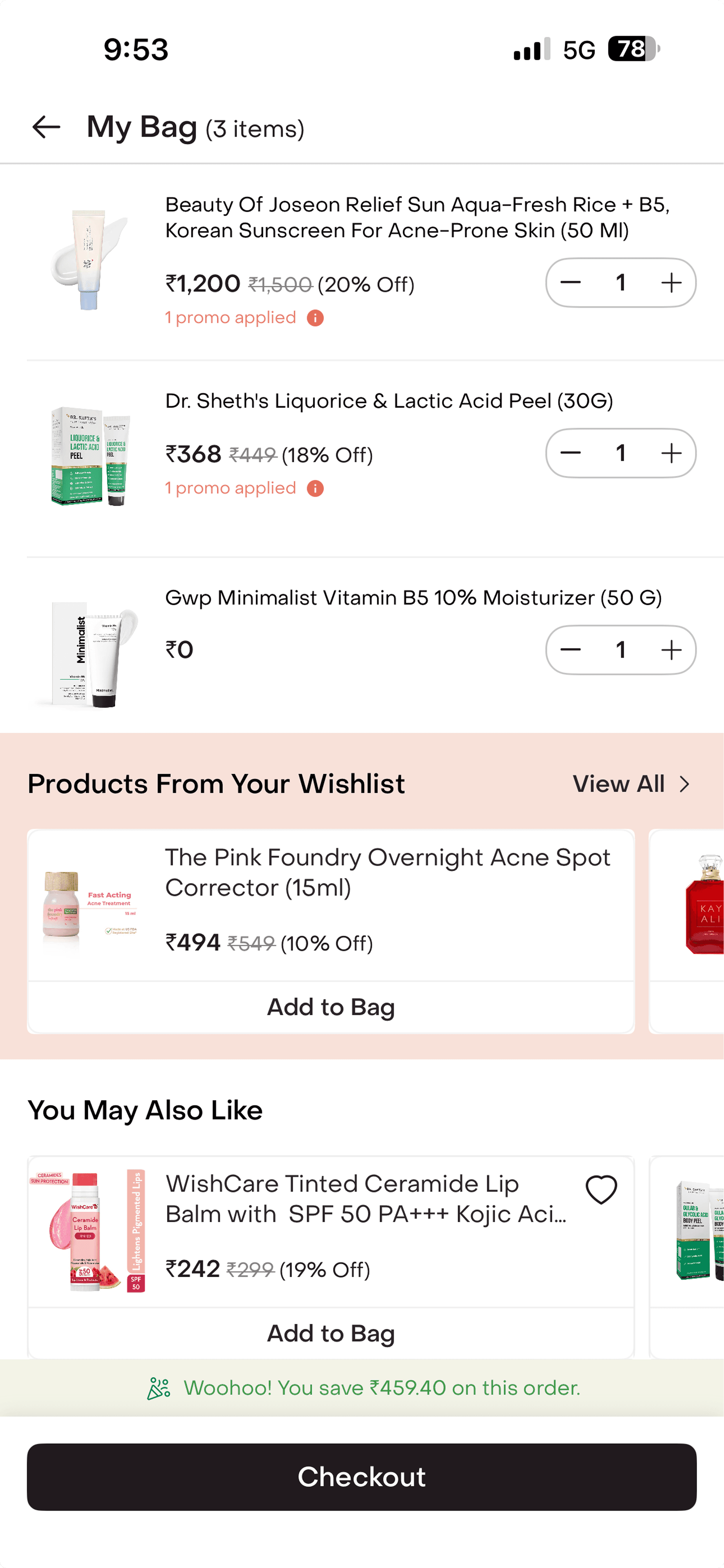
Tira
Competitor 2 — Bottom Placement
Free gift is placed at the bottom of the cart.
Insight: Poor placement reduces visibility, especially when users have multiple items — leading to missed opportunities. No clarity on free gift conditions.
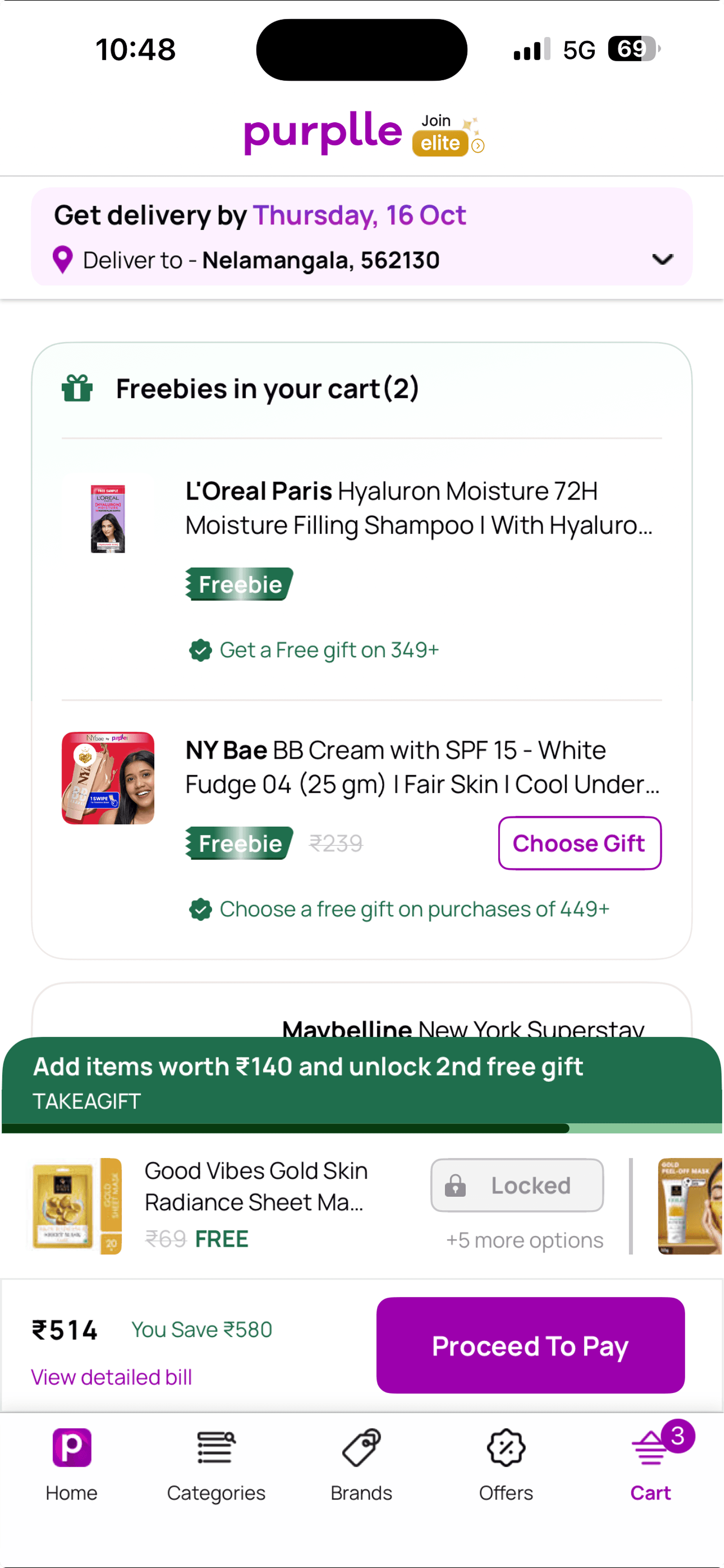
Purplle
Competitor 3 — Top but Cluttered
Free gift is visible early, but competes with multiple UI elements.
Insight: Even when visible at top, clutter can reduce effectiveness of incentives.
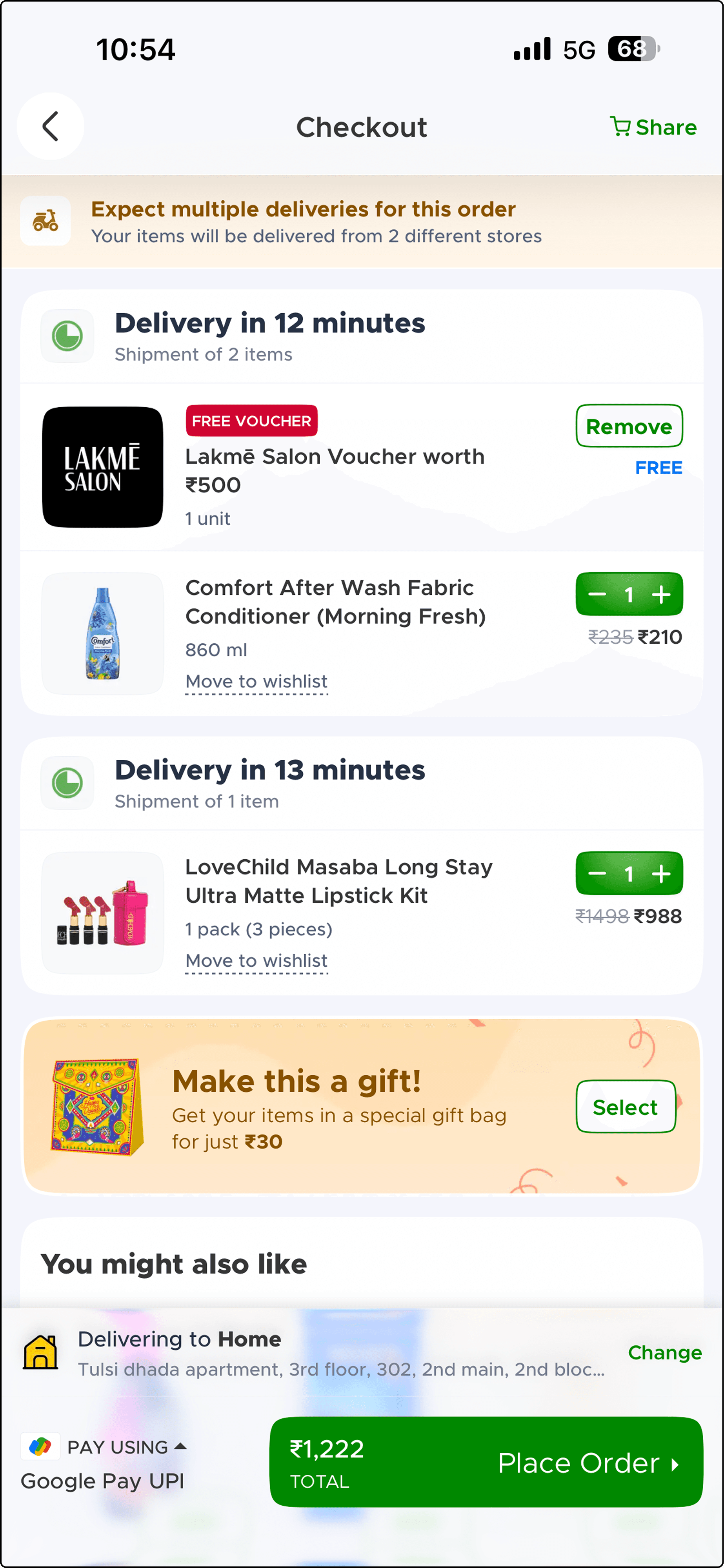
Blinkit
Competitor 4 — Contextual in Checkout
Incentives placed contextually within the checkout flow — visible alongside order details without disrupting the main experience.
Insight: Contextual communication improves understanding and trust.
Key Takeaways from Competitor Analysis
• Visibility at the top of the cart significantly improves awareness.
• Incentives need to be clearly distinguishable from other UI elements.
• Poor placement leads to missed opportunities even when offers exist.
• Contextual communication improves understanding and trust.
10 — Strategy
Solution Strategy
Based on the insights, the solution focused on reducing user effort and increasing visibility of incentives at the cart stage — the key decision point in the purchase journey.
Display Incentives Prominently
Surface the free gift and shipping offer at the top of the cart — where users are most likely to act on them.
Guide Toward Benefits
Guide users toward unlocking benefits — free gift and free shipping — through progress cues and clear messaging.
Reduce Cognitive Load
Simplify how offers are presented — remove clutter from the coupon section and communicate conditions clearly.
Problem Recap
• Users were unaware of how to unlock incentives
• Incentives were poorly placed and didn't influence decisions
• Shipping charges appeared unclear, creating friction and mistrust
11 — Design
Before vs. After
Before
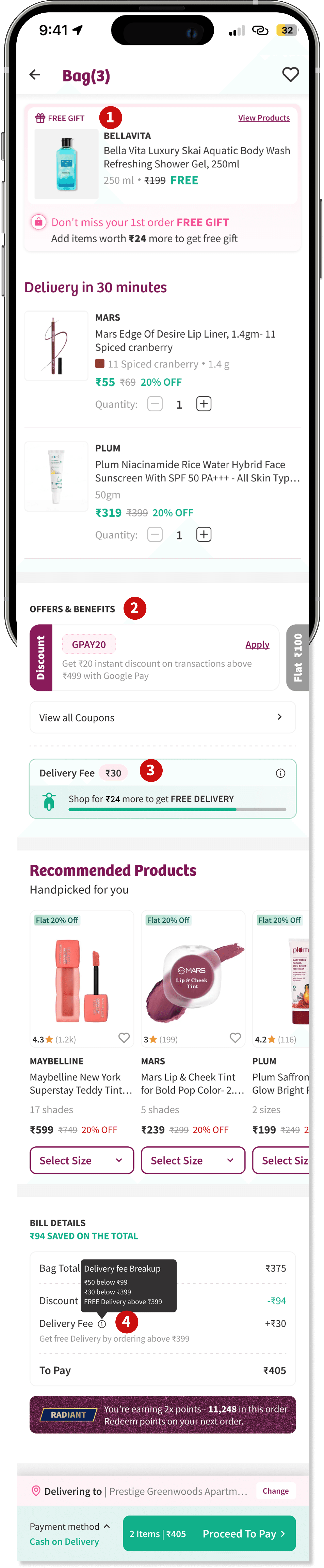
① Free gift eligibility was poorly positioned and lacked visibility, limiting its ability to influence purchase decisions.
② Delivery charges and their conditions were not clearly communicated, leading to confusion and mistrust.

After — 4 Key Changes
① Improved visibility of free gift
Moved the free gift card to the top of the cart and enhanced its visual prominence. Ensures users immediately see the incentive and understand its value.
② Simplified offers section
Removed the free gift from the coupon section and limited it to financial offers only. Reduces confusion and prevents dilution of key incentives.
③ Progress-based guidance
Added a progress bar showing how much more users need to spend to unlock free shipping. Helps users take action without needing to calculate or remember conditions.
④ Contextual clarity for charges
Introduced clear helper text explaining delivery charges and eligibility conditions. Builds trust and reduces drop-off caused by unexpected costs.
12 — Results
Impact & Results
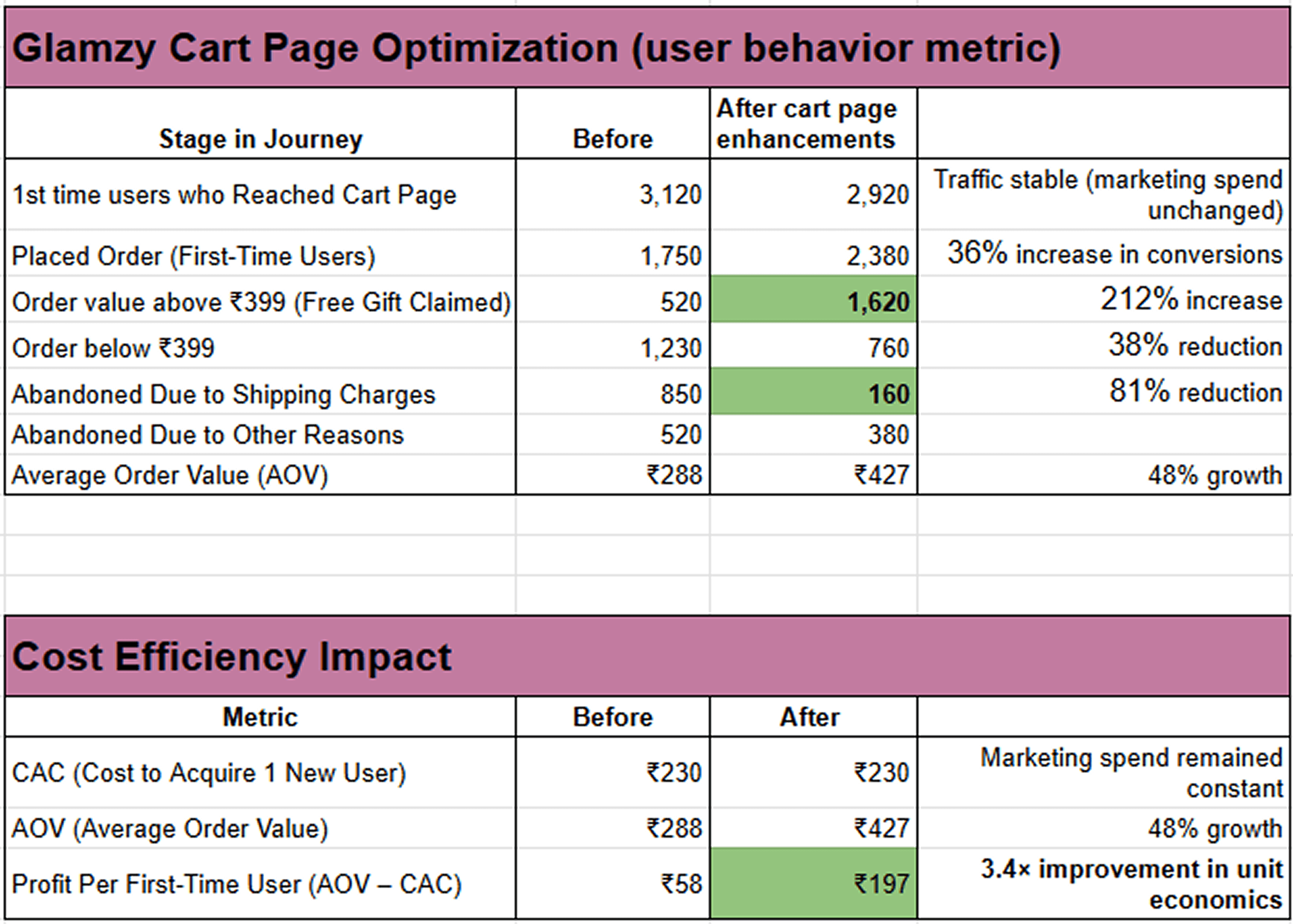
By improving free-gift visibility and clarifying shipping thresholds at the cart level, we shifted users from low-value to high-value purchases and improved overall conversion efficiency without increasing marketing spend.
+48%
Increase in AOV
₹288 → ₹427
+212%
Increase in free gift claims
−81%
Drop in shipping-related abandonment
The redesign transformed the cart from a drop-off point into a conversion driver — aligning user incentives with business goals.
13 — EXPERIENCE IN THE DETAILS
To ensure consistency and reinforce user expectations, the free gift experience was extended beyond the cart and integrated across key touchpoints in the app.
Home Page & PDP Visibility
•Introduced a clear banner to communicate the offer upfront.
• Provided a visual preview of free gift options to increase perceived value.
•Ensured consistency between what users see in ads and within the app.
•Reinforces the offer at the product exploration stage, maintaining continuity from ad to purchase.
Banner Design
The free gift experience banner was designed to be immediately visible and easily understandable.

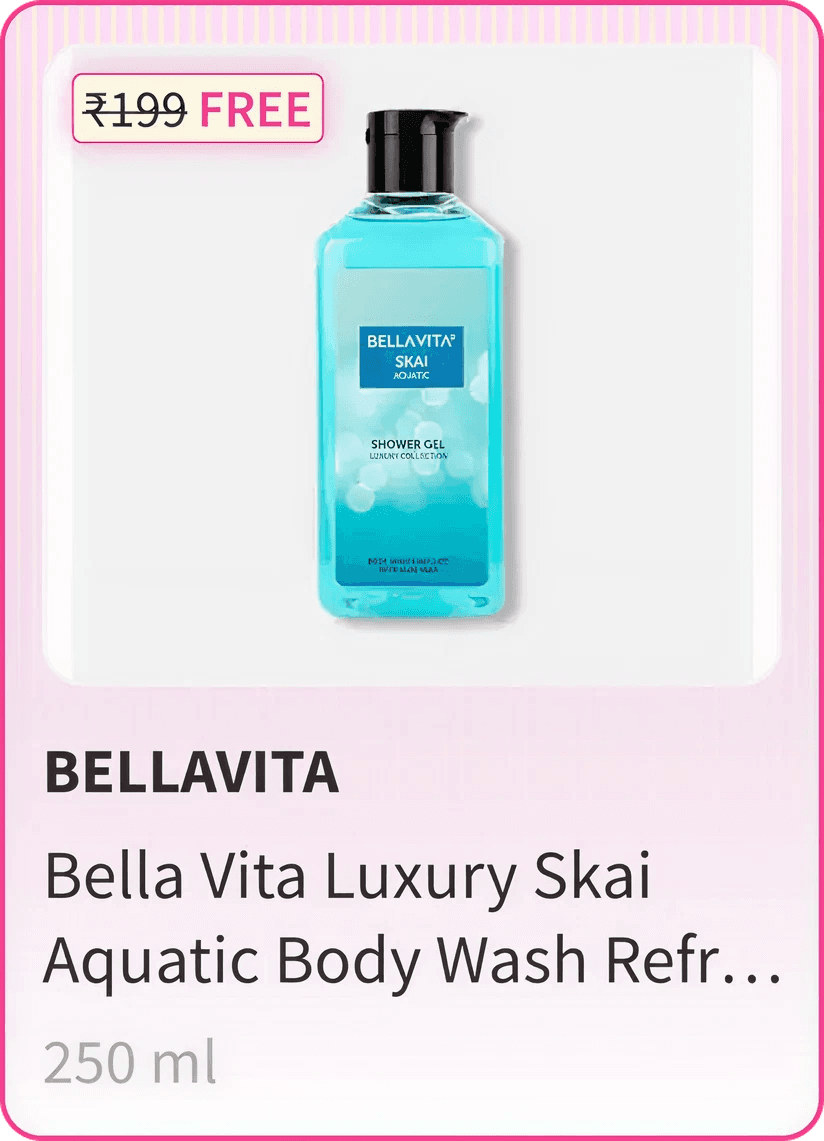
Free Gift Product Card
• The product card was designed to clearly communicate the value of the free gift with strong visual emphasis and minimal cognitive effort.
• The layout is scaleable and allows easy backend updates without requiring further design support.
Cart
Users can explore free gift options even before eligibility, with locked states guiding them toward required actions.

